The AI image generation landscape has witnessed a seismic shift with ByteDance's latest release: Seedream 5. As someone who has extensively tested every major AI image generator from Midjourney to Nano Banana Pro, I can confidently say that Seedream 5 represents a watershed moment in the evolution of text-to-image technology. This isn't just another incremental update—it's a fundamental reimagining of what AI-generated visuals can achieve in professional workflows.
ByteDance, the tech giant behind TikTok and the massively popular Doubao AI platform with over 159 million users, has been quietly building one of the most sophisticated image generation ecosystems in the industry. With Seedream 5, they've addressed the persistent pain points that have plagued creators, designers, and marketers for years: inconsistent character rendering, poor text legibility, and the dreaded "AI look" that screams artificial rather than authentic.
What Makes Seedream 5 a Game-Changer?
The release of Seedream 5 comes at a critical juncture when the AI image generation market is experiencing explosive growth. According to recent industry data, over 34 million AI images are created daily in 2025, and generative AI reached 15 billion images in approximately 1.5 years—a milestone that took traditional photography nearly 149 years to achieve. In this hyper-competitive landscape, Seedream 5 distinguishes itself through several breakthrough capabilities that directly address real-world creative challenges.
Deep Logic and Real-World Physics Understanding
Unlike previous generations that often produced anatomically impossible results or defied basic physics, Seedream 5 incorporates sophisticated understanding of spatial relationships, environmental logic, and material properties. This means when you prompt for "a glass of water on a wooden table with afternoon sunlight," the model doesn't just place random elements together—it comprehends how light refracts through liquid, how shadows fall based on sun angle, and how wood grain interacts with natural lighting.
This advancement stems from ByteDance's investment in what they call "deep reasoning mode," predicted to be a flagship feature targeting Google's Nano Banana Pro. When you input complex prompts like "Design an aerodynamic 2050 concept car," Seedream 5 doesn't simply generate a futuristic vehicle. The model first conceptualizes sketches, calculates airflow structures using its enhanced formula and chart rendering abilities, and then produces the final photorealistic render. This multi-stage reasoning process represents a quantum leap for industrial design, architectural visualization, and product development workflows.
4K High-Fidelity Output with Cinematic Quality
Professional creators have long struggled with AI-generated images that look impressive at thumbnail size but fall apart under scrutiny. Seedream 5 tackles this head-on with native 4K resolution support (3840×2160 pixels), delivering images with the density and detail required for print media, large-format displays, and high-end digital campaigns. The model produces visuals with realistic textures, natural shadows, accurate lighting, and sophisticated color palettes that rival professional photography.
The cinematic quality isn't just about resolution—it's about compositional intelligence. Seedream 5 demonstrates an innate understanding of visual storytelling principles: rule of thirds, leading lines, depth of field, and color theory. When generating scenes, the model creates images that feel intentionally composed rather than randomly assembled, with clear focal points and professional-grade aesthetic cohesion.
Revolutionary Text Rendering Capabilities
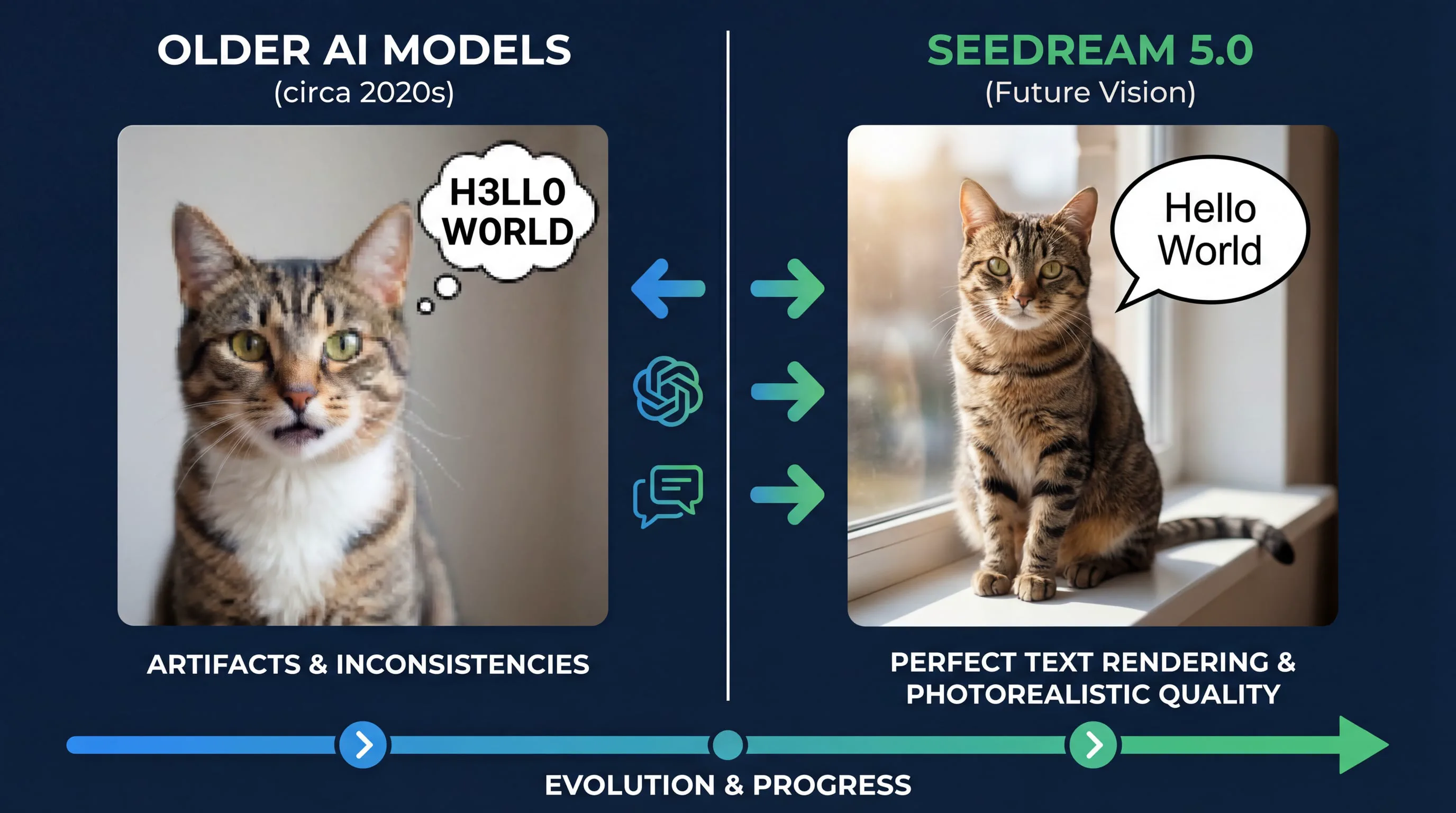
Perhaps the most celebrated breakthrough in Seedream 5 is its exceptional text rendering capability—a feature that has historically been the Achilles' heel of AI image generators. While most models struggle to produce legible typography, often creating gibberish or distorted letters, Seedream 5 can accurately generate readable text within images, handling both English and Chinese typography with clean visual hierarchies.
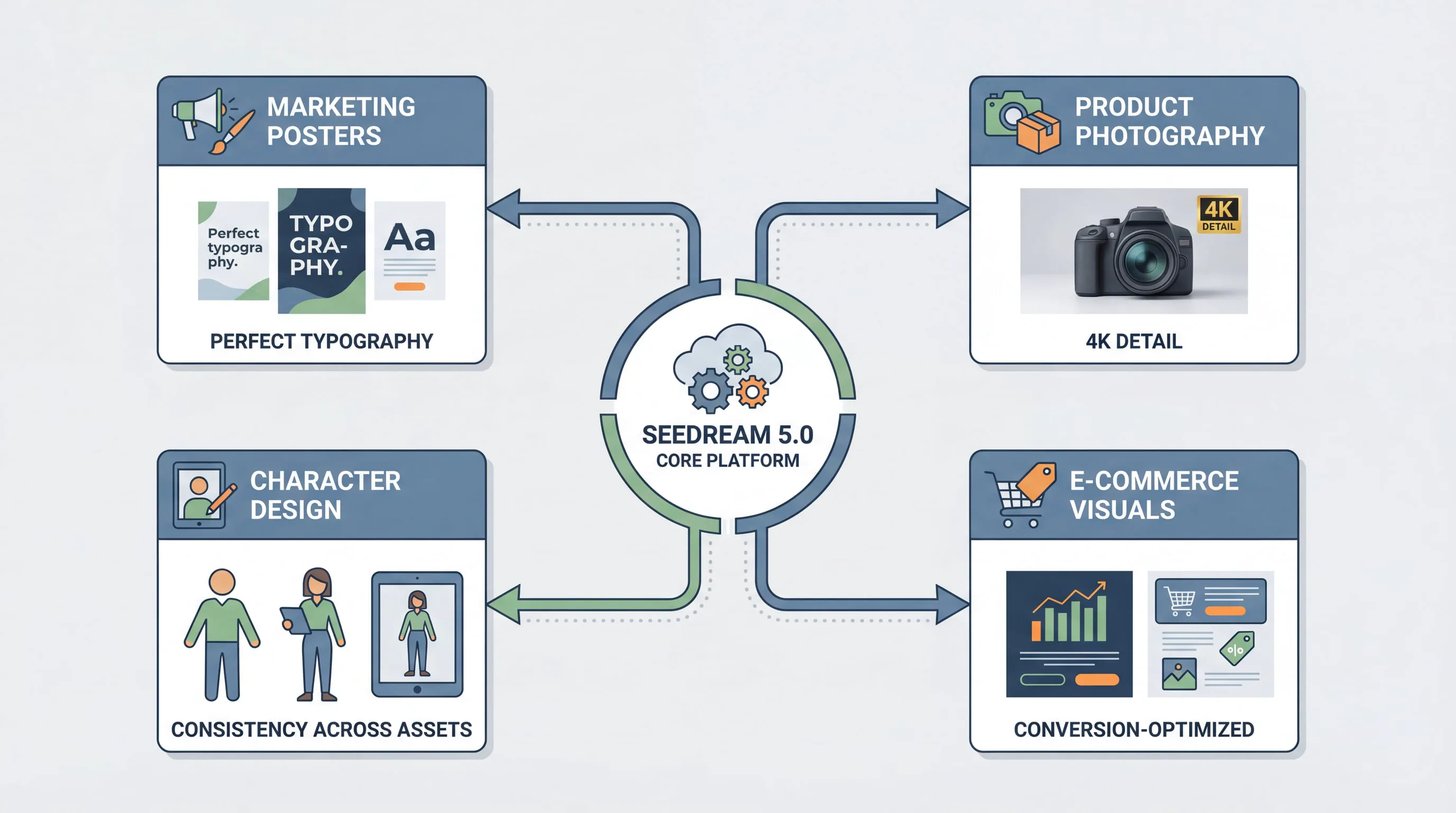
This capability transforms Seedream 5 from a mere image generator into a comprehensive design tool. Marketing professionals can now create promotional posters with specific branding and text, designers can generate signage with accurate spelling, and e-commerce teams can produce product mockups with clear labels—all without needing to manually add text in post-production. The model handles everything from neon signs and street banners to product packaging and wedding invitations with professional-grade typography.
Seedream 5 vs. The Competition: A Comprehensive Analysis
To understand Seedream 5's position in the market, we need to examine how it stacks up against established players. The AI image generation space in 2026 is dominated by several key competitors, each with distinct strengths and target audiences.
Seedream 5 vs. Midjourney: Photorealism Meets Artistic Expression
Midjourney has long been celebrated for its artistic flair and cinematic aesthetic. The platform excels at creating stylized, dreamlike visuals with a signature "Midjourney look" that many creators love. However, this artistic interpretation comes at a cost: prompt fidelity and structural accuracy often take a backseat to aesthetic appeal.
Seedream 5 takes a fundamentally different approach. Where Midjourney interprets your prompt through an artistic lens, Seedream 5 focuses on photorealism, structural accuracy, and reliable character rendering. This makes Seedream 5 significantly more suitable for commercial and production-grade work where brand consistency and precise specifications matter.
Key Differences:
| Feature | Seedream 5 | Midjourney V7 |
|---|---|---|
| Primary Strength | Photorealism & consistency | Artistic interpretation & style |
| Text Rendering | Excellent (readable, accurate) | Poor (often gibberish) |
| Character Consistency | High (multi-image reference system) | Moderate (character drift common) |
| Prompt Adherence | Very High | Moderate (artistic interpretation) |
| Ideal Use Cases | Commercial work, product photography, marketing materials | Concept art, moodboards, creative exploration |
| Pricing Model | Usage-based API | Subscription tiers |
| 4K Output | Native support | Available in higher tiers |
For creators who need a character to maintain identical facial features, clothing, and proportions across multiple scenes—think brand mascots, comic book characters, or advertising campaigns—Seedream 5's multi-image reference system provides unparalleled consistency. Midjourney users frequently report "character drift" where subtle features change between generations, requiring extensive manual correction.
Seedream 5 vs. Nano Banana Pro: The Precision Showdown
Google's Nano Banana Pro (Gemini 2.5) represents another heavyweight in the AI image generation arena, particularly praised for its deep intent recognition and logical consistency. Both Seedream 5 and Nano Banana Pro target professional users who demand precision and reliability.
Nano Banana Pro's greatest strength lies in its integration with Google's broader AI ecosystem and its sophisticated understanding of complex, multi-subject scenes. The model excels at maintaining character consistency across different prompts and settings, with particular prowess in handling subtle details like clothing textures and facial expressions. For projects requiring a single, recognizable character in various poses or settings, Nano Banana Pro's character identity preservation is exceptional.
However, Seedream 5 offers several competitive advantages:
Text Rendering: While Nano Banana Pro has improved its text capabilities, Seedream 5's typography rendering remains superior, particularly for dense text layouts and small fonts. In head-to-head tests, Seedream 5 achieved approximately 89% text accuracy compared to Nano Banana Pro's 71%, meaning nearly a third of Nano Banana Pro's text outputs require manual fixes—a significant time investment for marketing campaigns.
Speed and Iteration: Seedream 5 generates images in approximately 2-3 seconds, enabling rapid iteration and experimentation. This speed advantage becomes crucial in professional workflows where time equals money. Nano Banana Pro, while powerful, typically requires 5-8 seconds per generation.
Unified Architecture: Seedream 5 integrates image generation and editing into a single, cohesive system. You don't switch between "generate" and "edit" modes—the entire workflow is fluid and intuitive. This unified approach, combined with strong text rendering, makes Seedream 5 particularly powerful for creating promotional materials with specific branding requirements.
Cost Efficiency: For high-volume commercial work, Seedream 5 offers more competitive pricing through platforms like SeaDance AI, with typical costs ranging from $0.12-0.20 per image compared to Nano Banana Pro's $0.134-0.24 per image. For teams generating hundreds or thousands of images monthly, this difference compounds significantly.
Industry experts increasingly recommend a hybrid approach: using Seedream 5 for bulk production work and Nano Banana Pro for fine-tuning and specialized character work. This combination can reduce costs by 70% while maintaining quality across diverse use cases.
Seedream 5 vs. DALL-E and GPT Image: Integration vs. Specialization
OpenAI's DALL-E 3 and GPT Image 1.5 benefit from deep integration with ChatGPT, making them incredibly accessible for casual users. The conversational interface allows users to refine images through natural dialogue, and the preset style options (Cyberpunk, Anime, Dramatic Headshot, etc.) provide helpful guardrails for non-designers.
However, for professional applications, Seedream 5 offers several critical advantages:
Resolution and Detail: DALL-E and GPT Image typically output at lower resolutions (1024×1024 or 1536×1024), while Seedream 5 natively supports 4K output. For print work, large displays, or any application requiring zoom capability, this resolution difference is non-negotiable.
Text Accuracy: While GPT Image 1.5 has improved text rendering, it still struggles with complex layouts and dense typography—areas where Seedream 5 excels.
Commercial Licensing: Seedream 5 provides clear commercial usage rights through API platforms, while OpenAI's terms require careful review and may have restrictions depending on your use case.
Customization and Control: Professional designers often need precise control over composition, lighting, and style. Seedream 5's advanced prompting capabilities and multi-image reference system provide this granular control, while DALL-E's simplified interface, though user-friendly, can feel limiting for complex projects.
Core Features That Define Seedream 5
Multi-Image Reference System for Unprecedented Consistency
One of the most frustrating aspects of AI image generation has been the inability to maintain consistency across multiple outputs. You create a perfect character in one generation, then watch helplessly as their facial features morph in the next attempt. Seedream 5's multi-image reference system solves this problem elegantly.
The system allows you to upload multiple reference images to guide style, character appearance, and layout. The AI accurately identifies main subjects across these inputs and preserves critical details: facial features, lighting conditions, color tones, clothing textures, and even subtle elements like jewelry or tattoos. This capability proves invaluable for:
-
Brand Mascots: Maintain perfect consistency across hundreds of marketing materials
-
Comic Book Creation: Keep characters identical across panels and pages
-
Product Photography: Generate variations while preserving product identity
-
Storyboarding: Create cohesive visual narratives with consistent characters and environments
The technical implementation is sophisticated yet user-friendly. Simply upload your reference images, provide your prompt, and Seedream 5 analyzes the inputs to understand which elements should remain consistent and which can vary. The model doesn't just copy-paste elements—it understands the underlying characteristics and recreates them with appropriate adjustments for new contexts, poses, and lighting conditions.
Advanced Editing Capabilities Without Mode Switching
Traditional AI image workflows often require switching between different tools or modes: one for generation, another for editing, a third for refinement. Seedream 5 eliminates this friction with its unified architecture that seamlessly blends creation and modification.
Need to change a character's clothing while preserving everything else? Simply specify the edit in your prompt. Want to swap a background while maintaining the original lighting and mood? Seedream 5 handles it without redrawing the entire scene from scratch. This approach to editing feels more like collaborating with a skilled designer than wrestling with rigid software.
The editing capabilities extend to:
-
Object Replacement: Swap products, props, or elements while maintaining scene coherence
-
Background Modification: Change environments without affecting foreground subjects
-
Text Updates: Modify signage, labels, or typography without regenerating the entire image
-
Lighting Adjustments: Alter time of day, light sources, or atmospheric conditions
-
Detail Enhancement: Refine specific areas without impacting the overall composition
This integrated editing approach dramatically accelerates professional workflows. Instead of generating dozens of variations hoping to get the right combination of elements, you can iteratively refine a single image toward perfection, saving both time and API costs.
Enhanced Typography and Dense Text Rendering
The breakthrough in text rendering deserves deeper exploration because it fundamentally expands Seedream 5's utility. Previous AI models treated text as decorative elements, often producing unreadable gibberish that looked vaguely letter-like from a distance. Seedream 5 treats typography as a first-class design element with semantic meaning.
The model handles multiple text rendering scenarios with professional-grade results:
Small Font Clarity: Even at small sizes, text remains crisp and legible—critical for product labels, fine print, or detailed infographics.
Complex Layouts: Multi-column designs, grid-based typography, and hierarchical text structures maintain proper alignment and spacing.
Stylized Typography: The model can generate text in various styles—neon signs, hand-painted letters, embossed text, watercolor calligraphy—while maintaining readability.
Multilingual Support: Both English and Chinese typography render accurately, with proper character formation and cultural design conventions.
Contextual Integration: Text doesn't look pasted on—it integrates naturally with the scene, following perspective, receiving appropriate lighting, and showing realistic material properties (reflective metal letters, weathered wood signs, glowing neon, etc.).
For marketing teams, this capability eliminates the time-consuming process of generating an image, then manually adding text in Photoshop or Illustrator. You can now specify exact text in your prompt and receive publication-ready results. This workflow acceleration translates to significant cost savings and faster campaign deployment.
Real-World Applications and Use Cases
E-Commerce and Product Photography
E-commerce businesses constantly need fresh product imagery: lifestyle shots, seasonal variations, different color options, and contextual scenes. Traditional photography requires expensive shoots, models, locations, and post-production. Seedream 5 transforms this equation.
Consider a footwear brand launching a new sneaker line. With Seedream 5, they can:
-
Generate the same shoe in 20 different colorways without physical samples
-
Place the product in diverse lifestyle contexts (urban streets, gym settings, outdoor trails)
-
Create seasonal campaigns (summer beach scenes, winter snow backgrounds)
-
Produce size-specific marketing (children's versions with playground settings, adult versions with professional contexts)
-
Test marketing concepts rapidly before committing to expensive photo shoots
A real-world example: An e-commerce team needed to create promotional images for a sneaker changing from white to electric teal, placed on a wet urban street at blue hour with puddles reflecting neon signs, while keeping exact shape and texture. Midjourney V6 required eight variations and still warped the laces. Seedream 5 nailed it on the second attempt, demonstrating its superior understanding of material properties and scene composition.
Marketing and Advertising Campaigns
Marketing teams face relentless pressure to produce fresh creative assets across multiple channels, formats, and audience segments. Seedream 5 enables unprecedented agility in campaign development.
Rapid Concept Testing: Generate dozens of creative directions in hours rather than weeks, allowing data-driven decisions about which concepts resonate before investing in full production.
Localization at Scale: Create culturally appropriate visuals for different markets by adjusting settings, characters, and contextual elements while maintaining core brand identity.
A/B Testing Visuals: Produce multiple variations of the same concept to test which visual approaches drive better engagement and conversion.
Seasonal Adaptations: Quickly adapt core creative assets for holidays, seasons, or trending events without full reshoots.
Personalized Creative: Generate audience-specific variations that speak directly to different demographic segments, increasing relevance and engagement.
The speed and cost advantages are transformative. A traditional advertising campaign might require weeks of planning, location scouting, casting, shooting, and post-production, costing tens of thousands of dollars. With Seedream 5, marketing teams can explore creative concepts in days for a fraction of the cost, reserving expensive production budgets for final execution of proven concepts.
Content Creation and Social Media
Content creators and social media managers face an insatiable demand for fresh, engaging visuals. Seedream 5 provides the production capacity to maintain consistent output without sacrificing quality.
Character-Driven Content: Create a consistent character or mascot that appears across all your content, building brand recognition and audience connection.
Trend Participation: Quickly generate visuals for trending topics or viral formats while they're still relevant.
Educational Content: Produce clear, professional diagrams, infographics, and illustrated explanations that enhance learning.
Storytelling: Develop visual narratives with consistent characters, settings, and style across multiple posts or episodes.
Platform Optimization: Generate the same core visual in multiple aspect ratios and compositions optimized for different platforms (Instagram square, YouTube thumbnail, Pinterest vertical, etc.).
Influencers and content creators particularly benefit from Seedream 5's character consistency features. Building a recognizable visual brand requires maintaining consistent aesthetics across hundreds of posts—a challenge that Seedream 5's multi-image reference system solves elegantly.
Design and Creative Exploration
Professional designers increasingly use AI as a collaborative tool rather than a replacement. Seedream 5 excels in this collaborative role, accelerating the creative process while leaving final artistic decisions to human expertise.
Rapid Prototyping: Quickly visualize multiple design directions before committing to detailed execution.
Client Presentations: Generate polished concept visuals for client presentations, helping stakeholders visualize ideas before investing in full production.
Mood Boards: Create cohesive collections of images that establish visual direction for projects.
Style Exploration: Test different artistic approaches, color palettes, and compositional strategies rapidly.
Reference Generation: Create custom reference images for specific needs rather than searching stock photo libraries.
The key insight is that Seedream 5 doesn't replace designer expertise—it amplifies it. A skilled designer can explore ten times as many creative directions in the same timeframe, leading to better final outcomes through more thorough exploration of the solution space.
Technical Specifications and Performance Benchmarks
Understanding Seedream 5's technical capabilities helps contextualize its performance advantages and appropriate use cases.
Model Architecture and Training
Seedream 5 represents a significant architectural evolution from its predecessors. While ByteDance hasn't disclosed complete technical details, industry analysis suggests the model incorporates:
Hybrid Architecture: Combining multimodal and parallel diffusion transformer blocks, allowing simultaneous processing of text, image, and style information.
Massive Parameter Count: Estimated at 12+ billion parameters, providing the capacity to understand nuanced prompts and generate highly detailed outputs.
Diverse Training Data: Trained on carefully curated datasets spanning multiple domains, artistic styles, and cultural contexts, enabling broad applicability.
Physics-Aware Training: Specialized training on real-world physics, material properties, and spatial relationships, explaining the model's superior understanding of how objects interact in three-dimensional space.
Performance Metrics
ByteDance uses an internal benchmark called MagicBench for multi-dimensional evaluation. According to official data, Seedream 5 shows significant improvements across core dimensions:
Prompt Adherence: The model accurately interprets and implements complex prompts with multiple requirements, maintaining fidelity to user intent.
Aesthetic Quality: Professional-grade composition, lighting, and color harmony that rivals human photography.
Structural Accuracy: Proper proportions, realistic anatomy, and logical spatial relationships.
Text Rendering Accuracy: Approximately 89% accuracy for in-image text generation, substantially higher than competing models.
Generation Speed: 2-3 seconds for standard resolution, 5-8 seconds for 4K output, enabling rapid iteration.
Consistency Score: High reliability in maintaining character and style consistency across multiple generations when using reference images.
Output Specifications
-
Maximum Resolution: 4K (3840×2160 pixels) native support
-
Aspect Ratios: Flexible support for common ratios (1:1, 16:9, 9:16, 4:3, 3:2, and custom)
-
File Formats: PNG (lossless), JPEG (compressed), WebP (optimized for web)
-
Color Space: sRGB standard, with support for wider gamuts in professional workflows
-
Bit Depth: 8-bit standard, 16-bit available for professional applications
How to Access Seedream 5
ByteDance has made Seedream 5 accessible through multiple channels, catering to different user needs and technical capabilities.
Official Platforms
Doubao App: Chinese users can access Seedream 5 through ByteDance's flagship Doubao AI platform, which serves over 159 million daily active users. However, international access requires a Chinese phone number (+86), creating barriers for global users.
Dreamina (CapCut): ByteDance has integrated Seedream 5 into Dreamina, the AI image generation tool within CapCut. This provides a user-friendly interface for creators already in the CapCut ecosystem.
Third-Party API Platforms
For developers and businesses requiring API access, several platforms provide Seedream 5 integration:
Seedance AI: Offers streamlined access to Seedream 5 with competitive pricing and multi-model support. The platform provides simple registration, clear documentation, and aggregates multiple AI models (Seedream 5, Nano Banana Pro, GPT Image 1.5) in one place, eliminating vendor lock-in.
BytePlus: ByteDance's official enterprise API platform, providing direct access with enterprise support and SLAs.
Volcengine: Another official channel, particularly popular in Asian markets.
Evolink: Aggregation platform offering Seedream 5 alongside competing models, with pricing approximately 40-60% cheaper than official channels (¥0.12-0.20 per image).
Choosing the Right Access Method
For Casual Users: Dreamina/CapCut provides the most accessible entry point with a user-friendly interface and no technical requirements.
For Content Creators: Platforms like SeaDance AI offer the right balance of ease-of-use and flexibility, with reasonable pricing for moderate usage volumes.
For Developers: API platforms (BytePlus, Volcengine, APIYI) provide the programmatic access needed for integration into existing workflows and applications.
For Enterprises: Direct BytePlus access offers enterprise support, custom pricing, and SLAs appropriate for mission-critical applications.
Pricing and Cost Considerations
Understanding the economics of AI image generation helps optimize your workflow and budget allocation.
Typical Pricing Structure
-
Official Channels: $0.15-0.25 per image for standard resolution, $0.30-0.50 for 4K output
-
Third-Party Aggregators: $0.12-0.20 per image, with volume discounts available
-
Enterprise Contracts: Custom pricing based on volume commitments and support requirements
Cost Comparison with Alternatives
| Platform | Cost per Image | 4K Support | Text Rendering | Best For |
|---|---|---|---|---|
| Seedream 5 | $0.12-0.25 | Yes (native) | Excellent | Commercial work, marketing |
| Nano Banana Pro | $0.134-0.24 | Yes | Good | Character consistency, complex scenes |
| Midjourney | ~$0.20-0.40* | Yes (higher tiers) | Poor | Artistic exploration, concept art |
| DALL-E 3 | ~$0.04-0.08 | No | Moderate | Casual use, quick iterations |
| GPT Image 1.5 | Included in ChatGPT Plus | Limited | Moderate | Integrated workflows, conversational refinement |
*Midjourney pricing based on subscription tiers divided by typical usage
Cost Optimization Strategies
Hybrid Workflows: Use Seedream 5 for final production assets and lower-cost models for initial exploration and concept development.
Batch Processing: Generate multiple variations in single sessions to maximize API efficiency.
Prompt Refinement: Invest time in crafting precise prompts to reduce the number of generations needed to achieve desired results.
Reference Image Strategy: Use the multi-image reference system to get closer to target results on first attempts, reducing iteration costs.
Platform Selection: Choose API platforms based on your usage patterns—high-volume users benefit from aggregator platforms with volume discounts.
Best Practices for Seedream 5
Maximizing Seedream 5's capabilities requires understanding how to communicate effectively with the model through prompts and references.
Prompt Engineering for Seedream 5
Be Specific and Layered: Describe subjects, composition, spatial relationships, lighting, style, and constraints in clear, structured language. Instead of "a woman in a park," try "a woman in her 30s with shoulder-length brown hair, wearing a blue sundress, sitting on a park bench under dappled sunlight filtering through oak trees, warm afternoon lighting, shallow depth of field, professional portrait photography style."
Specify Text Explicitly: When you need readable text, include the exact wording in quotes within your prompt: "Create a neon sign that reads 'OPEN 24/7' in bright blue letters against a brick wall at night."
Describe Lighting Intentionally: Lighting dramatically impacts mood and quality. Specify light sources, direction, quality (hard/soft), and color temperature: "golden hour backlight," "overcast diffused lighting," "dramatic side lighting with deep shadows."
Include Style References: Mention specific photographic or artistic styles: "shot on Fujifilm," "in the style of Annie Leibovitz," "cinematic composition," "minimalist product photography."
Leverage Negative Prompts: Specify what you don't want to avoid common AI artifacts: "no distorted hands, no extra fingers, no watermarks, no text artifacts."
Multi-Image Reference Strategy
Character Consistency: Upload 2-4 images of the same character from different angles to establish their identity. The model will extract consistent features across all reference images.
Style Transfer: Use reference images to establish artistic style, color palette, or compositional approach. The model will apply these aesthetic principles to your new generation.
Layout Guidance: Reference images can guide composition and spatial arrangement, helping achieve specific framing or perspective.
Hybrid Approach: Combine character references with style references to maintain subject consistency while applying new artistic treatments.
Iterative Refinement Workflow
-
Start Broad: Generate initial concepts with clear but flexible prompts to explore possibilities
-
Identify Winners: Select the generations that best align with your vision
-
Refine Specifically: Use editing capabilities to adjust specific elements rather than regenerating entirely
-
Reference Integration: Upload successful generations as references for subsequent iterations to maintain consistency
-
Final Polish: Make targeted adjustments to lighting, composition, or details for publication-ready results
Limitations and Considerations
While Seedream 5 represents a significant advancement, understanding its limitations helps set realistic expectations and plan appropriate workflows.
Current Limitations
Complex Hand Poses: While improved from previous versions, intricate hand positions or gestures can still occasionally produce anatomical inconsistencies. Review carefully when hands are prominent in your composition.
Extreme Photorealism: For certain applications requiring absolute photographic fidelity (forensic work, medical imaging, scientific documentation), AI-generated images may not yet meet professional standards.
Cultural Nuances: While trained on diverse datasets, the model may not perfectly capture subtle cultural details, traditional clothing specifics, or region-specific architectural elements without detailed prompting.
Legal and Ethical Considerations: AI-generated images of real people, trademarked products, or copyrighted characters raise complex legal questions. Consult legal counsel for commercial applications involving recognizable individuals or brands.
Prompt Interpretation Variability: Complex prompts with many requirements may prioritize some elements over others. Iterative refinement often needed for precise results.
When to Choose Alternative Tools
Artistic Exploration: Midjourney's stylized aesthetic may better serve pure creative exploration without commercial constraints.
Quick Casual Use: ChatGPT's integrated DALL-E provides faster access for simple, one-off generations.
Character Animation: Specialized tools like Seedance 1.5 Pro (ByteDance's video model) better serve animation and motion needs.
Extreme Customization: Stable Diffusion with custom training may provide more control for highly specialized applications.
The Future of Seedream: What's Next?
ByteDance's roadmap for the Seedream family suggests exciting developments on the horizon.
Predicted Seedream 5.1 Features
Image-to-Video Integration: Seamless conversion of static images to animated sequences, blurring the line between image and video models.
Layer-wise Generation: Generated images with editable layers, bridging the gap between AI generation and professional design tools like Photoshop or Figma.
Enhanced Reasoning Mode: Deeper multi-step reasoning for complex creative briefs, particularly valuable for industrial design and architectural visualization.
Real-time Generation: Edge computing optimization for near-instantaneous generation on mobile devices.
3D-Aware Generation: Understanding of three-dimensional space enabling consistent object rotation and perspective shifts.
Industry Implications
The rapid advancement of AI image generation fundamentally reshapes creative industries. By 2026, Gartner predicts that 90% of all digital content will be AI-generated. This doesn't mean human creativity becomes obsolete—rather, the nature of creative work evolves from execution to direction, from production to curation.
Professional designers, photographers, and artists who embrace AI as a collaborative tool gain significant competitive advantages: faster iteration, broader exploration of creative possibilities, and the ability to deliver more value to clients. Those who resist risk obsolescence as client expectations shift toward rapid turnaround and unlimited variation.
The democratization of visual creation also means more people can participate in creative expression. Small businesses that couldn't afford professional photography can now produce marketing materials that compete visually with major brands. Independent creators can produce content at scales previously requiring entire production teams.
Conclusion: Seedream 5's Place in Your Creative Toolkit
Seedream 5 represents a pivotal moment in AI image generation, delivering on long-standing promises of photorealistic quality, consistent character rendering, and professional-grade typography. For commercial applications, marketing campaigns, product photography, and brand development, it offers compelling advantages over both artistic-focused tools like Midjourney and general-purpose solutions like DALL-E.
The model's greatest strengths—text rendering accuracy, multi-image consistency, 4K output, and unified editing workflow—directly address the pain points that have prevented broader professional adoption of AI image generation. These aren't incremental improvements; they're transformative capabilities that fundamentally change what's possible in creative workflows.
However, Seedream 5 isn't a universal solution. Artistic exploration may still benefit from Midjourney's stylized approach. Simple, casual use cases may find ChatGPT's integrated DALL-E more convenient. Extreme customization needs might require Stable Diffusion's flexibility. The optimal approach for most professionals involves a hybrid strategy: leveraging Seedream 5's strengths for production work while maintaining access to complementary tools for specialized needs.
For businesses and creators evaluating AI image generation tools in 2026, Seedream 5 deserves serious consideration. Its combination of quality, consistency, and commercial viability makes it particularly well-suited for professional applications where brand integrity and production efficiency matter. The platform's accessibility through services like Seedance AI removes technical barriers, making enterprise-grade AI image generation available to businesses of all sizes.
As AI image generation continues its rapid evolution, staying informed about new capabilities and best practices becomes increasingly important. Seedream 5 sets a new benchmark for what's possible, and understanding how to leverage its capabilities effectively provides significant competitive advantages in our increasingly visual digital landscape.
The future of visual creation isn't human versus AI—it's human creativity amplified by AI capabilities. Seedream 5 represents a powerful tool in that collaborative future, enabling creators to bring their visions to life with unprecedented speed, quality, and consistency. The question isn't whether to adopt AI image generation, but how to integrate it most effectively into your creative process to deliver better results, faster, at lower cost.
For those ready to explore what Seedream 5 can do for their creative workflows, the time to start is now. The technology is mature, accessible, and proven. The competitive advantages are real and measurable. And the creative possibilities are limited only by imagination.