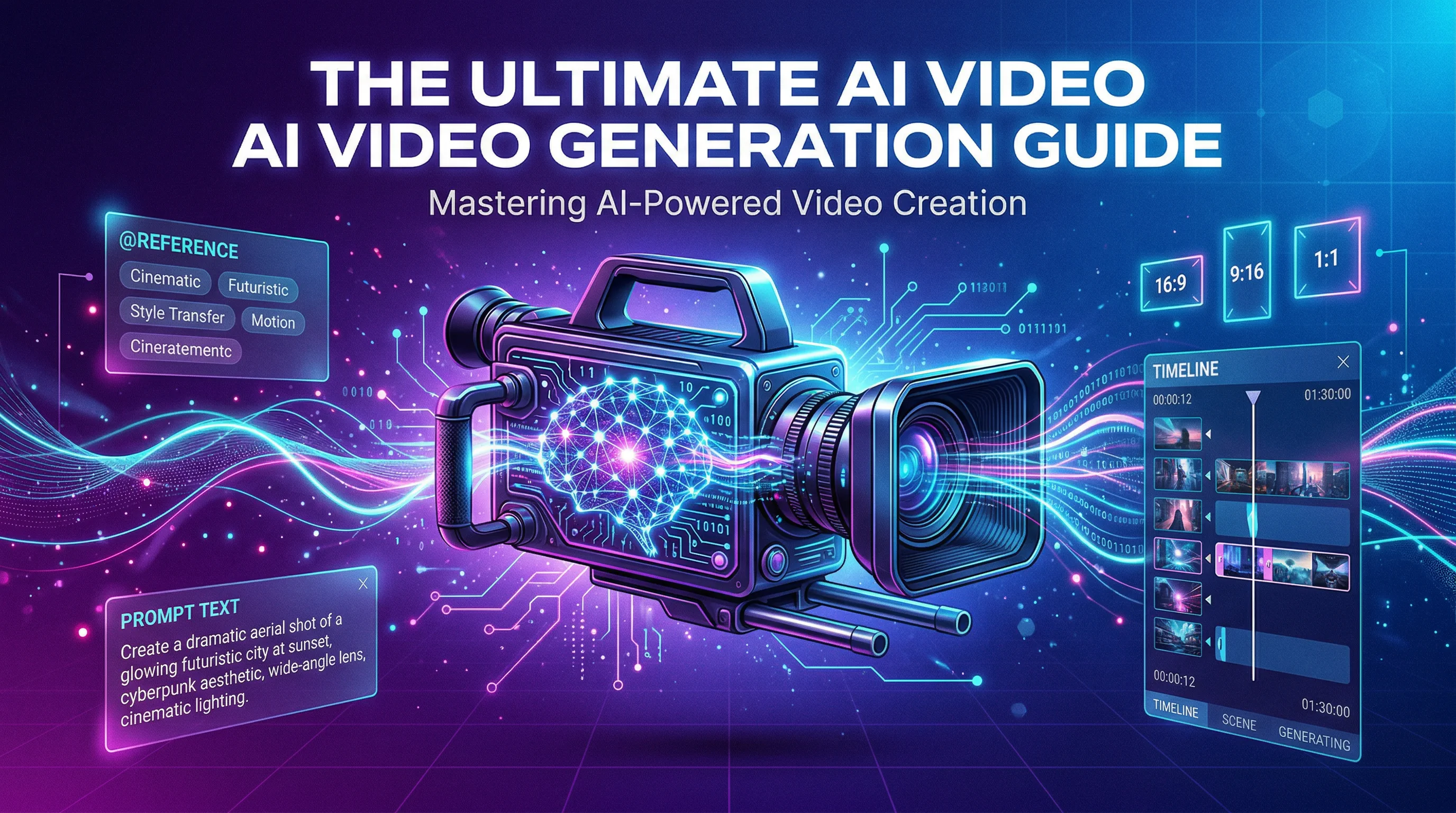
Alt text: Professional magazine cover-style illustration comparing four AI video generation models - Kling 3.0, Seedance 2.0, Sora 2 Pro, and Veo 3.1
Introduction: The AI Video Revolution Has Arrived
The AI video generation landscape has undergone a seismic transformation in early 2026. What once required expensive production crews, professional cameras, and weeks of post-production can now be accomplished with a text prompt and a few minutes of processing time. The competition among leading AI video models has intensified dramatically, with three major launches — Kling 3.0, Sora 2 Pro, and Seedance 2.0 — arriving within weeks of each other, fundamentally reshaping how creators approach visual storytelling.
Six months ago, most AI video models generated silent output with limited motion realism and obvious artifacts. In February 2026, four of the six major models — Kling 3.0, Sora 2, Veo 3.1, and Seedance 2.0 — now generate synchronized audio natively. Dialogue, ambient sound, and sound effects have become part of the generation process rather than a post-production afterthought.
This comprehensive guide provides an in-depth analysis of the four most capable AI video generation models available today. Based on extensive research, real-world testing data, and technical benchmarks, we compare Kling 3.0, Seedance 2.0, Sora 2 Pro, and Veo 3.1 across all dimensions that matter to professional creators, marketers, and filmmakers. By the end of this guide, you will understand exactly which model suits your specific workflow, budget, and creative requirements.
The State of AI Video Generation in 2026
A Market Transformed
The AI video generation market has shifted more in the first six weeks of 2026 than it did in all of Q3 and Q4 2025 combined. Each model now represents a fundamentally different approach to video generation — from multimodal control to physics simulation to cinematic quality prioritization.
Several key trends define this new era:
-
Native Audio Generation: Synchronized dialogue, sound effects, and ambient audio are now standard features across leading models
-
Extended Duration: Maximum clip lengths have expanded from 4-8 seconds to 15-25 seconds
-
Higher Resolutions: True 1080p output is now the baseline, with some models supporting up to 2K
-
Multimodal Inputs: Text, images, audio, and video can all serve as generation inputs
-
Character Consistency: Advanced reference systems enable consistent character appearance across multiple shots
Model Overview: The Four Contenders
Kling 3.0 (Kuaishou)
Launched on February 4, 2026, Kling 3.0 represents a major architectural evolution from Kuaishou, the company behind one of the world's largest short-video platforms. Built on a unified multimodal framework, Kling 3.0 generates synchronized video and audio in a single pass rather than generating them separately and stitching them together.
Key Technical Specifications:
-
Maximum resolution: 1080p
-
Maximum duration: 10-15 seconds per clip
-
Frame rate: 24 FPS
-
Architecture: Unified multimodal framework
-
Native audio: Yes, synchronized generation
Kling 3.0 distinguishes itself through exceptional motion accuracy and scene continuity. The model addresses the persistent problem of distorted limbs and unstable camera movement that plagued earlier generations. The upgraded Kling Motion Control system allows for precise manipulation of camera movements and subject motion.
Notable features include:
-
Motion Brush: Paint motion paths directly onto source images to specify exactly how elements should move
-
Character Cloning: Extract a person's likeness from footage (though testing shows facial likeness can drift and lip-sync remains inconsistent)
-
Kling 3 Edit: Robust video-to-video editing mode for style transfer and refining existing footage
-
Multi-image References: Upload several images of the same person to maintain consistency across different scenes
Professional videographers have rated Kling 3.0 as "arguably the most capable general-purpose video model available right now" and "state-of-the-art overall" for natural movement and physics simulation.
Seedance 2.0 (ByteDance)
ByteDance launched Seedance 2.0 on February 10, 2026, and the AI video community quickly recognized it as a structural leap rather than an incremental update. Built on a unified multimodal audio-video joint generation architecture, this model rewrites assumptions about temporal consistency, motion coherence, and prompt adherence.
Key Technical Specifications:
-
Default resolution: 1080p (export up to 2K available)
-
Maximum duration: Up to 15 seconds with multi-shot support
-
Frame rate: 24 FPS
-
Architecture: Unified multimodal audio-video joint generation
-
Native audio: Yes, dual-channel stereo audio with dialogue
Seedance 2.0's most distinctive feature is its unmatched multi-reference system. The " @ reference" system allows creators to attach up to 9 images, 3 videos, and 3 audio files as context — a level of multimodal input control unavailable in any competing model.
The model's cinematic capabilities have earned particularly high marks:
-
Camera Control: Scored 9/10 in benchmark testing — the highest among all competing models
-
Motion Smoothing: Produces more natural, film-like results with superior motion smoothing and camera tracking
-
Environmental Continuity: Maintains consistency longer through improved memory compression in the transformer backbone
-
Joint Generation: Audio and visual information inform each other during creation, ensuring tight synchronization
Independent benchmarks from Lanta AI Research (February 2026) demonstrate Seedance 2.0's leadership in cinematic quality metrics. The model excels at slow tracking shots, dramatic dolly zooms, smooth pans, and even handheld-style movements executed with remarkable precision.
Sora 2 / Sora 2 Pro (OpenAI)
OpenAI's Sora 2 launched in December 2025, with the Pro tier becoming available in January 2026. The dual-tier offering represents OpenAI's second-generation video generation system, adding synchronized dialogue and sound effects alongside improved scene physics.
Key Technical Specifications (Standard Sora 2):
-
Maximum resolution: 720p
-
Maximum duration: 10-15 seconds
-
Architecture: Diffusion Transformer
-
Native audio: Yes, background soundscapes, speech, and effects
Key Technical Specifications (Sora 2 Pro):
-
Maximum resolution: 1080p
-
Maximum duration: Up to 25 seconds
-
Enhanced computational investment per frame
-
Native audio: Yes, with superior quality
The standard Sora 2 handles basic video creation needs efficiently, consuming approximately 16 credits per second at 720p resolution. A 10-second clip costs 160 credits, meaning Plus subscribers with 1,000 monthly credits can generate about six 10-second videos.
Sora 2 Pro requires a ChatGPT Pro subscription ($200/month) and includes 10,000 monthly credits. The Pro version invests more computational power into each frame, resulting in better texture detail, more realistic lighting, and smoother motion. Independent testing shows Sora 2 Pro scored 8.2/10 for realism and 7.9/10 for prompt accuracy in blind tests by professional videographers.
Unique capabilities include:
-
Character Injection: Insert real people into generated environments with accurate portrayal of appearance and voice
-
Complex Physics: Generate scenes that accurately model dynamics like buoyancy, rigidity, and complex motion (Olympic gymnastics, paddleboard backflips)
-
Video-to-Video Editing: Modify existing footage with AI-driven transformations
Veo 3.1 (Google DeepMind)
Google's Veo 3.1, launched in January 2026, represents the latest iteration of Google's video generation technology. The model introduces several new capabilities that make it particularly well-suited for mobile-first content creation and professional workflows alike.
Key Technical Specifications:
-
Supported resolutions: 720p, 1080p, and 4K
-
Duration options: 4, 6, or 8 seconds
-
Frame rate: 24 FPS
-
Aspect ratios: 16:9 (landscape) and 9:16 (portrait)
-
Native audio: Yes, natively generated
Veo 3.1 introduces three distinct generation modes:
-
Standard Model: Works with Text-to-Video and Multi Reference Mode for maximum quality and subject consistency. Supports 1-3 reference images to maintain character identity across frames.
-
Fast Model: A lighter-weight version ideal for rapid generation and controlled motion, working with Text-to-Video and Start & End Frame features.
-
Ingredients to Video: Upload multiple reference images to direct characters, objects, and style for dynamic storytelling.
The model excels in prompt adherence — evaluations using MovieGenBench showed participants rated Veo 3.1 highest for accurately following prompts. The "Ingredients to Video" feature specifically addresses identity consistency, making it ideal for brand content and character-driven narratives.
Head-to-Head Comparison
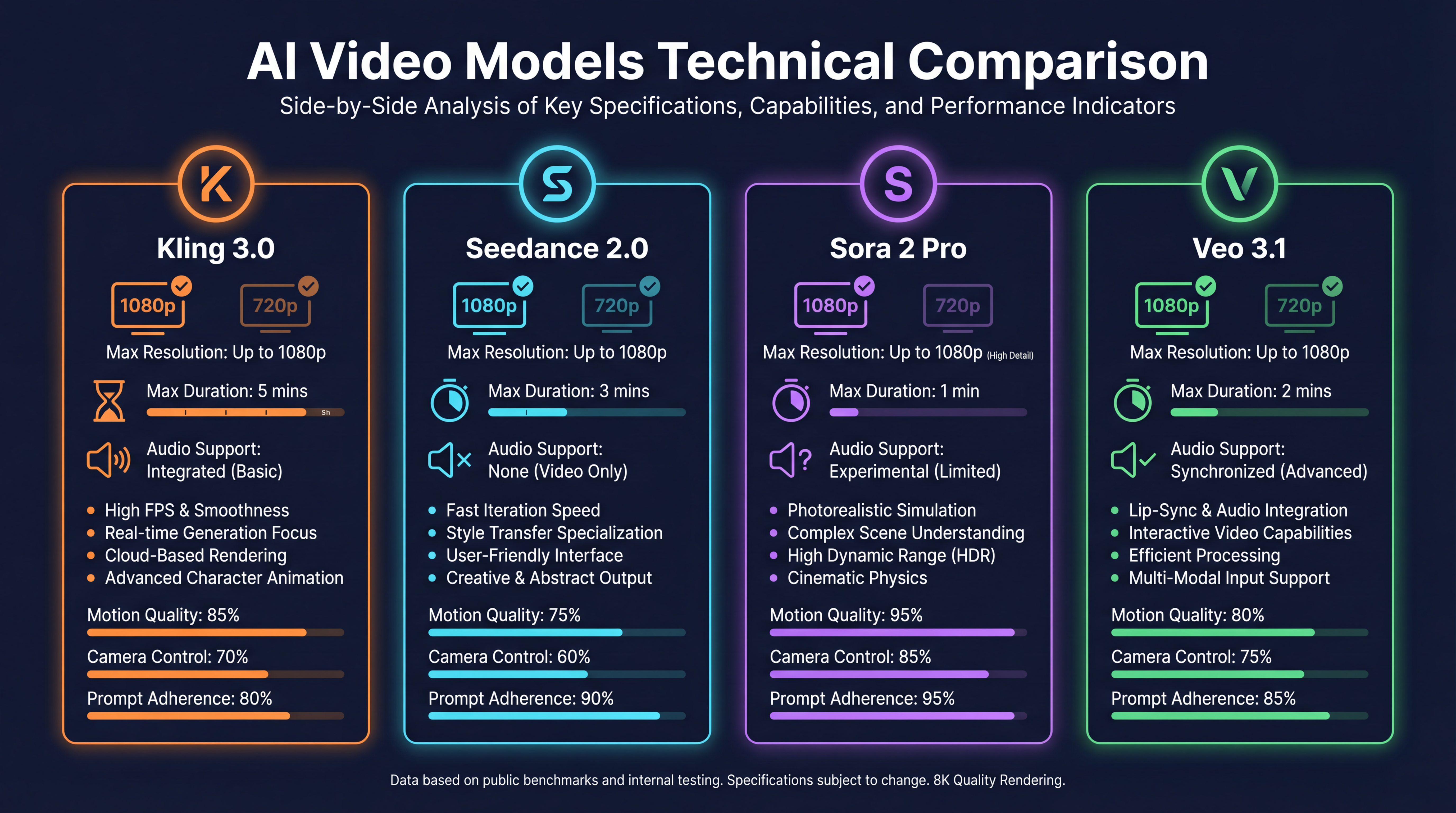
Alt text: Professional infographic comparing technical specifications of Kling 3.0, Seedance 2.0, Sora 2 Pro, and Veo 3.1 AI video models
Technical Specifications Comparison
| Feature | Kling 3.0 | Seedance 2.0 | Sora 2 Pro | Veo 3.1 |
|---|---|---|---|---|
| Provider | Kuaishou | ByteDance | OpenAI | |
| Launch Date | Feb 4, 2026 | Feb 10, 2026 | Dec 2025 | Jan 2026 |
| Max Resolution | 1080p | 1080p (up to 2K export) | 1080p | 720p/1080p/4K |
| Max Duration | 10-15 seconds | 15 seconds | 25 seconds | 4-8 seconds |
| Native Audio | Yes | Yes (dual-channel) | Yes | Yes |
| Frame Rate | 24 FPS | 24 FPS | 24 FPS | 24 FPS |
| Aspect Ratios | Multiple | Multiple | Multiple | 16:9 & 9:16 |
| Architecture | Unified Multimodal | Audio-Video Joint | Diffusion Transformer | Advanced Transformer |
Performance Benchmarks
Based on independent testing and published benchmarks, here's how the models compare across critical quality dimensions:
| Metric | Kling 3.0 | Seedance 2.0 | Sora 2 Pro | Veo 3.1 |
|---|---|---|---|---|
| Motion Realism | 9.0/10 | 9.2/10 | 8.2/10 | 8.5/10 |
| Camera Control | 8.5/10 | 9.0/10 | 7.8/10 | 8.0/10 |
| Prompt Adherence | 8.5/10 | 8.8/10 | 7.9/10 | 9.0/10 |
| Character Consistency | 8.0/10 | 8.5/10 | 8.0/10 | 8.8/10 |
| Audio Quality | 8.0/10 | 9.0/10 | 8.5/10 | 8.0/10 |
| Processing Speed | Fast | Medium | Medium | Fast/Fast+ |
Ratings based on independent testing from Lanta AI Research, Curious Refuge, and community benchmarks from February 2026
Detailed Analysis by Use Case
For Cinematic Storytelling and Filmmaking
Best Choice: Seedance 2.0
Seedance 2.0 demonstrates a clear advantage for cinematic storytelling. Its motion smoothing and camera tracking produce more natural, film-like results. The model's understanding of cinematic principles shows in proper depth of field, realistic lighting that responds to environmental conditions, and motion blur that mimics professional camera work.
The camera control system supports:
-
Slow tracking shots
-
Dramatic dolly zooms
-
Smooth pans
-
Handheld-style movements
The multi-shot audio-video capability allows for narrative sequences with consistent characters across shots — essential for pre-visualization and short-form storytelling.
Runner-up: Kling 3.0
Kling 3.0's motion brush feature gives filmmakers precise control over subject movement. The model excels at maintaining character consistency through multi-image references, making it suitable for recurring characters in serialized content.
For Marketing and Commercial Content
Best Choice: Veo 3.1
Veo 3.1's "Ingredients to Video" feature provides unmatched control over brand elements. Upload product images, logos, and style references to ensure consistent visual identity across generated content. The model's strength in prompt adherence means marketing copy translates accurately to visual output.
Key advantages for marketers:
-
Multi-reference system maintains brand consistency
-
Vertical video (9:16) support for social media optimization
-
Fast generation mode for rapid iteration
-
Integration with Google Workspace and Gemini ecosystem
Runner-up: Seedance 2.0
For high-end commercial work requiring 2K output and professional color grading, Seedance 2.0's superior camera control and motion smoothing justify the additional processing time.
For Social Media Content Creators
Best Choice: Kling 3.0
Kling 3.0 offers the best balance of quality, speed, and ease of use for social media creators. The Fast Track generation reduces wait times to approximately 3 minutes per clip, enabling rapid content iteration. The character cloning feature, while not perfect, provides a foundation for faceless YouTube channels and avatar-based content.
Runner-up: Veo 3.1 Fast Model
For mobile-first creators already using Google tools, Veo 3.1's integration with Gemini and YouTube Shorts provides a seamless workflow.
For Rapid Prototyping and Concept Development
Best Choice: Sora 2 (Standard)
The standard Sora 2 offers the most cost-effective solution for rapid iteration. Lower credit consumption allows creators to explore multiple variations quickly. The 25-second capability of Sora 2 Pro makes it valuable for testing longer narrative sequences.
Runner-up: Veo 3.1 Fast
The lightweight Fast model provides quick generation for early-stage concept validation.
Pricing and Accessibility
Understanding the cost structure is essential for selecting the right model for your budget:
Kling 3.0
-
Free tier available with queue times (~1 hour)
-
Premium plans offer Fast Track generation (~3 minutes)
-
Pay-as-you-go and subscription options
Seedance 2.0
-
Enterprise and developer API access
-
Higher per-generation cost but professional-grade output
-
Pricing scales with resolution and duration requirements
Sora 2 / Sora 2 Pro
-
Plus Plan: $20/month, 1,000 credits (~six 10-second 720p videos)
-
Pro Plan: $200/month, 10,000 credits, access to Sora 2 Pro (1080p, up to 25 seconds)
-
Credit consumption varies by resolution and duration
Veo 3.1
-
Google AI Pro: Access to Veo 3.1 Fast
-
Google AI Ultra: Highest access tier with full features
-
Integrated into Google Workspace pricing for enterprise users
Practical Recommendations
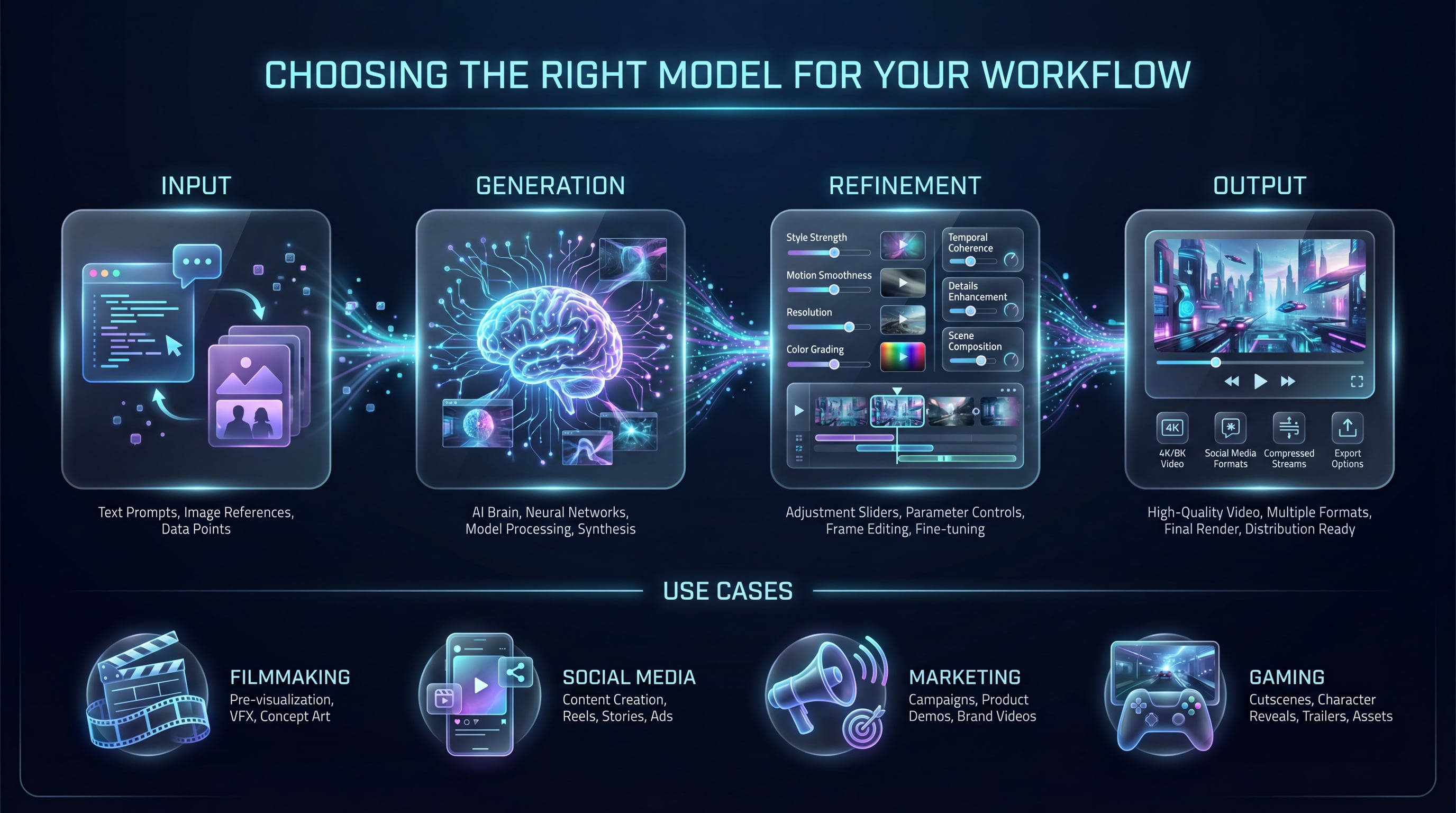
Alt text: Workflow infographic showing the AI video generation process from input to output with use case applications
For Professional Production Teams
Many production teams now use multiple models in their workflow:
-
Pre-visualization: Use Veo 3.1 Fast or Sora 2 for rapid concept testing
-
Asset Generation: Leverage Kling 3.0 for character-based content and motion-specific scenes
-
Final Delivery: Use Seedance 2.0 for high-quality client presentations and broadcast-ready output
-
Extended Sequences: Sora 2 Pro for longer narrative content up to 25 seconds
For Individual Creators
-
Budget-conscious: Start with Kling 3.0's free tier or Sora 2 Plus
-
Quality-focused: Invest in Seedance 2.0 for portfolio work
-
Speed-focused: Use Veo 3.1 Fast for daily content creation
-
Narrative content: Consider Sora 2 Pro for storytelling projects
Key Decision Factors
When choosing between these models, consider:
-
Output Resolution Needs: If 4K is required, Veo 3.1 is your only option
-
Duration Requirements: For clips over 15 seconds, Sora 2 Pro offers up to 25 seconds
-
Audio Importance: Seedance 2.0 leads in audio-visual synchronization quality
-
Camera Control: Seedance 2.0's 9/10 camera control score makes it ideal for cinematic work
-
Budget Constraints: Sora 2 Plus offers the most affordable entry point
-
Integration Needs: Veo 3.1 integrates seamlessly with Google Workspace
The Seedance AI Advantage
While each model offers unique strengths, accessing all four through separate platforms creates workflow friction and increased costs. This is where Seedance AI transforms the creative process.
Seedance AI offers seamless access to Kling 3.0, Seedance 2.0, Sora 2, and Veo 3.1 within a single, unified platform. Instead of managing multiple subscriptions, navigating different interfaces, and learning distinct prompting styles, creators can access the industry's leading video generation models through one intuitive dashboard.
Seedance AI eliminates the complexity of model selection by providing:
-
Unified Interface: One platform for all four models — no more switching between tabs or remembering different login credentials
-
Optimized Routing: Intelligent system recommends the best model for your specific prompt and use case
-
Cost Efficiency: Consolidated pricing eliminates redundant subscriptions
-
Streamlined Workflow: Export and manage all generated content from a single library
With Seedance AI, you can leverage Kling 3.0's exceptional motion control for action sequences, switch to Seedance 2.0 for cinematic camera work, use Sora 2 Pro for extended narrative content, and generate quick social clips with Veo 3.1 — all without leaving the platform.
The platform's architecture prioritizes user experience without sacrificing creative control. Whether you are a solo creator producing daily social content or a production team developing commercial campaigns, Seedance AI provides the infrastructure to maximize the potential of each model while minimizing operational overhead.
Explore how Seedance AI can transform your video creation workflow by visiting:
Conclusion: The Right Model for Your Creative Vision
The AI video generation landscape of 2026 offers unprecedented creative capabilities, but no single model dominates every use case. Your optimal choice depends on specific project requirements:
-
Choose Seedance 2.0 for cinematic storytelling, commercial work requiring 2K output, and projects demanding superior camera control
-
Choose Kling 3.0 for natural motion physics, character-based content, and rapid social media production
-
Choose Sora 2 Pro for extended narrative sequences up to 25 seconds and complex physics simulations
-
Choose Veo 3.1 for brand-consistent marketing content, 4K requirements, and mobile-first vertical video
The competitive pressure driving these innovations benefits all creators. Features that were cutting-edge six months ago — native audio, 1080p resolution, 10+ second durations — are now baseline expectations. The models continue to improve rapidly, with each update narrowing the gaps between them while pushing the boundaries of what's possible.
For creators seeking to leverage the full spectrum of AI video capabilities without managing multiple platforms, Seedance AI provides integrated access to all four models. This unified approach allows you to match the right technology to each creative challenge, optimizing both output quality and production efficiency.
The future of video creation is here — and it is more accessible, capable, and versatile than ever before.
Frequently Asked Questions
Which AI video model has the best motion realism?
Based on independent benchmarks, Seedance 2.0 scores highest for motion realism (9.2/10) followed closely by Kling 3.0 (9.0/10). Seedance excels in cinematic motion smoothing, while Kling leads in natural physics simulation.
Can these models generate videos longer than 15 seconds?
Sora 2 Pro currently offers the longest duration at 25 seconds per generation. Most other models max out at 10-15 seconds, though you can extend sequences through editing and combining clips.
Do all four models support native audio generation?
Yes. Kling 3.0, Seedance 2.0, Sora 2/Pro, and Veo 3.1 all generate synchronized audio including dialogue, sound effects, and ambient sound. Seedance 2.0 leads in audio quality with dual-channel stereo support.
Which model is best for beginners?
Kling 3.0 and Veo 3.1 offer the most accessible interfaces for beginners. Kling 3.0 provides intuitive motion controls, while Veo 3.1 integrates with familiar Google tools.
Can I use these models for commercial projects?
All four models permit commercial usage under their respective terms of service. Seedance 2.0 and Veo 3.1 specifically target professional workflows with broadcast-quality output standards.
How do I maintain character consistency across multiple clips?
Veo 3.1's Multi Reference Mode and Seedance 2.0's multi-reference system (up to 9 images) provide the best character consistency. Kling 3.0 also supports multi-image references for improved consistency.
Last Updated: March 1, 2026
Disclaimer: AI video generation technology evolves rapidly. Specifications and capabilities mentioned in this guide reflect information available as of March 2026. Always verify current features and pricing on official platforms before making purchasing decisions.